
In our programs, we’re seeing executives who are listening more closely than they were just two years ago. Anyone talking about AI today is speaking to people who have long since had their own experiences with it. They’ve tried out tools, heard the promises, and seen job descriptions change.
But what they also perceive is a gap: On one hand, senior management is announcing AI strategies with high efficiency expectations. On the other hand, many employees lack a clear path for how they themselves are supposed to fit into this strategy. This gap definitely does not call for yet another tool training session. This gap calls for a format that builds confidence in working with AI. We call it Learning Journeys.
TL;DR
- 99 percent of CEOs expect AI-related layoffs in the next two years, according to Mercer Global Talent Trends 2026 (Mercer, 2026).
- At the same time, only 32 percent believe their workforce can collaborate optimally with AI. This gap has a name: lack of empowerment.
- The percentage of employees who are “thriving” at work has dropped from 66 percent (2024) to 44 percent (2026). The main cause: fear of AI taking their jobs.
- Traditional AI training programs are too short, too technical, and too detached from real-world work to bridge this gap.
- Learning Journeys are the format we at triangility have been refining for years to close precisely this gap: learning processes spanning several months and guided by dialogue, which combine AI competence, reflection, and practical application—and thereby restore trust within the organization.
What AI Skepticism Means in a Corporate Context
Those who dismiss AI skepticism as irrational resistance overlook its substantive core. Respondents have good reasons. AI systems and large language models can be misused for cyberattacks, deepfakes, and manipulative content. Algorithms can reflect societal biases and skew decisions affecting people. With the EU AI Act 2024, the European Union has created, for the first time, a legal framework regulating high-risk applications. Skepticism, therefore, is not only driving the demand for stricter laws; it has already brought them about.
The complexity of this transformation is high. Unlike Industry 4.0, artificial intelligence alters cognitive activities that were previously considered irreplaceable, thus extending far beyond the automation of machines and processes. This creates uncertainty at all levels, from front-line staff to the executive board.
For business leaders, this means: AI offers a clear competitive advantage because it reduces routine tasks and creates space for strategic work. However, it delivers this advantage only if leaders build the strategic and ethical competencies necessary for responsible use. This is precisely where a leadership journey worthy of the name begins.
AI skepticism refers to a critical attitude toward the development, implementation, and use of artificial intelligence. In companies, it manifests as a combination of concern for one’s own job, mistrust of management’s promises, and a growing demand for governance, transparency, and ethical responsibility.
What is "AI Skepticism"?
Where the trust gap in artificial intelligence is most visible
The numbers are clear. According to Mercer Global Talent Trends 2026, the percentage of employees who describe themselves as “thriving” at work has fallen by 22 points within two years, from 66 to 44 percent. Mercer cites fear of AI taking their jobs as the main cause. This is not an economic downturn. It is a psychological fracture within the organization, as measured by a survey of approximately 12,000 people worldwide.
We see this shift in our programs first and foremost among younger employees. The generation that grew up on tech promises is now scrutinizing particularly closely whether the next promise is truly meant for them. We described this in detail in our magazine article on the Gen Z mindset. Anyone who wants to understand a workforce’s loss of trust is best off starting with the employees who are the first to notice when words and reality diverge.
This shift is also documented outside our training rooms. Robin Adrien Schwarz compiled it for HR Today (HR Today, 2026): CEOs are booed at public appearances; Microsoft complains about “AI slop.” This may seem trivial. It is symptomatic of a gap that doesn’t start with the tool. It begins with the experience that every tech wave of the past two decades made promises whose side effects people had to bear themselves. AI is the next wave. This time, the side effect hits their own jobs.
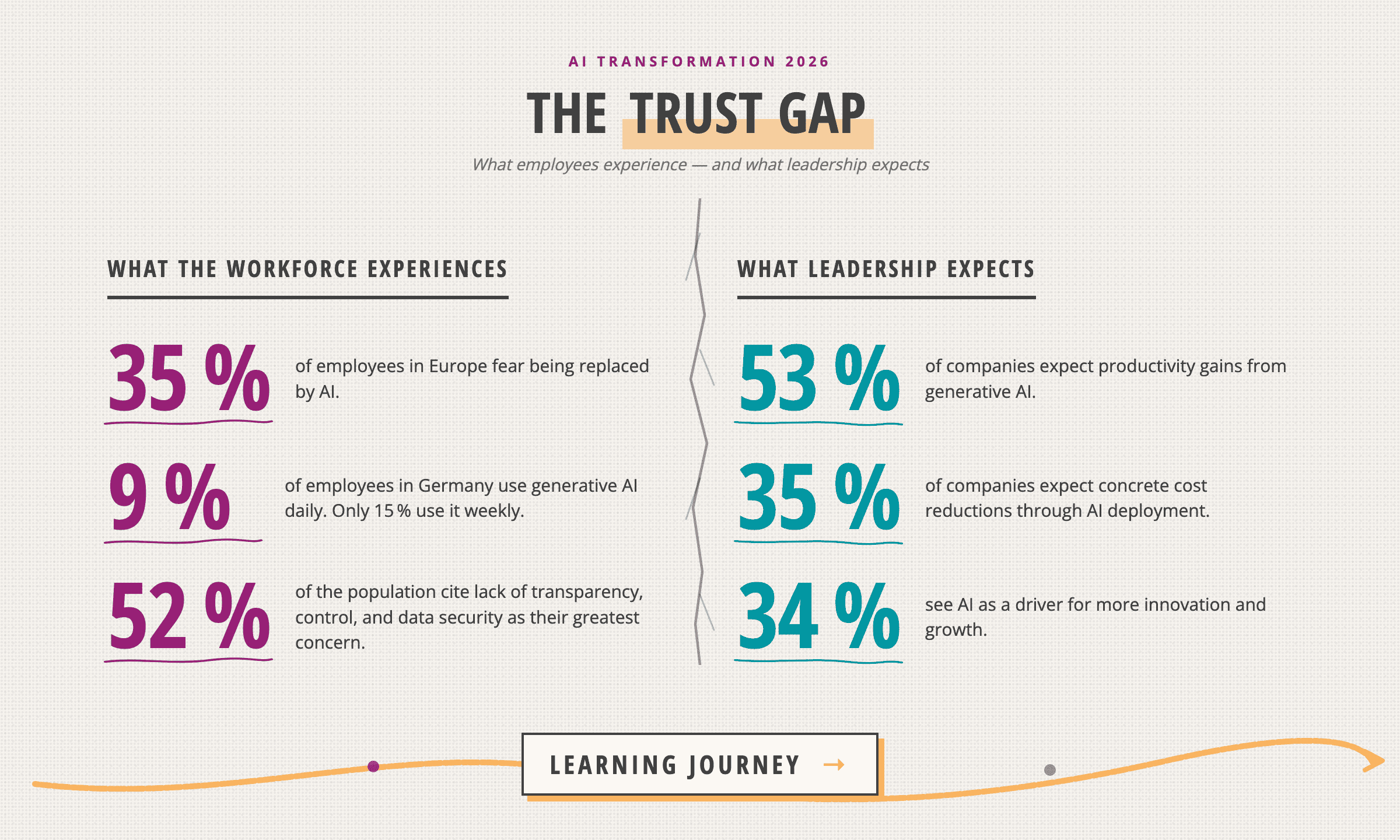
Four figures that make AI skepticism tangible
Recent studies from 2025 paint a consistent picture of employee sentiment in Germany and Europe:
- 35 percent of employees in Europe fear being replaced by AI systems or machines (EY European AI Barometer 2025). These fears are therefore not a marginal phenomenon. They lie at the core of one in three workforces.
- Only 9 percent of employees in Germany use generative AI daily, and 15 percent weekly (Bitkom 2025). Despite all the programs and updates, many lack clarity on how to use AI effectively in their own jobs.
- 52 percent of the population cite a lack of transparency, lack of control, and data security concerns as their biggest worries regarding AI (Bitkom 2025). This mistrust is found among employees and customers alike.
- 35 percent of companies expect cost reductions to be the key outcome of generative AI; productivity gains and innovation rank first at 53 and 34 percent, respectively (Deloitte AI Study 2025). Management thus expects tangible resource benefits from AI deployment, while their employees fear for their jobs. This transformation demands clarity, not speed.
Get regular access to exclusive insights from thought leaders and practical tools on topics such as digital evolution, cultural transformation, future-readiness, resilience, mindfulness, and the design of new work environments.
Why these fears are not impatience
The most common HR response to such figures is: “We need to get the workforce on board.” At triangility, we put it a bit more bluntly: Anyone who treats fears as a communication problem has already lost. The 99 percent of CEOs who expect layoffs and the 32 percent who believe their workforce can adapt to working with AI are describing the same reality from two perspectives. Employees have understood what management is saying. They just no longer believe that it will turn out well for them personally.
And they are right, as long as organizations do not offer their employees a clear path to their new roles. Trust comes from security. Security comes from empowerment. Empowerment comes from a format structured like our Learning Journeys.
Three Best Practices HR Should Avoid Right Now
In our initial conversations with HR leaders or even CIOs who are under pressure to readjust their AI strategy, we’re currently hearing three things—and none of them will get them out of this situation.
1. Communicate more
The assumption behind this is that skepticism is an information problem. It rarely is. It is usually a credibility problem. More newsletters, more town halls, and more AI champion programs actually reinforce skepticism if they are not followed by tangible changes in the reality of work.
2. More tool training
A two-day prompt engineering seminar, at best, builds proficiency with a tool. It does not build confidence in a role. Anyone returning to their daily work after such training faces the same question as before: Where can I use AI, where can’t I, and who bears responsibility if something goes wrong?
3. Silence on Job Cuts
Mercer’s 99 percent figure is circulating. Your employees know it. Those who remain officially silent in this situation leave the power of interpretation to the office grapevine. Clear statements about which roles will change, which will not, and what paths remain open are uncomfortable. They are the foundation of any empowerment that is taken seriously.
Hollowing of Work: Why Job Cuts and AI Competence Are Not Opposed
The term “Hollowing of Work” was recently coined to describe what is actually happening right now: Fewer jobs are being eliminated through rationalization; rather, roles are being hollowed out. The administrative assistant, the junior analyst, and the editor are seeing how the middle 60 percent of their tasks are being taken over by AI. What remains are the demanding 20 percent at the top end and the dirty 20 percent at the bottom end. The role formally remains, but it feels like a different one.
This is precisely where the holy grail lies buried—the Mercer gap between 99 and 32 percent. Senior management views the numbers through the lens of results: efficiency, margin, headcount planning. Employees experience the same numbers through the lens of identity:
Who will I be tomorrow in this role? Both perspectives are valid. Both need a shared space for processing. And we believe: A half-day training session is not that space.
What works: Learning to work with AI, not just talking about AI
This is where Learning Journeys come into play—the format we’ve been using for years to guide leaders and teams through precisely these phases.
A Learning Journey is a learning process for leaders and teams that spans several months, systematically combining AI competence, reflection, and concrete practical application—so that AI anxiety turns into AI confidence.
Three characteristics distinguish it from traditional training.
First: It proceeds in iterations. Instead of a two-day knowledge dump, learning modules, application sprints in daily work, and joint reflection sessions alternate. Participants bring real-world use cases, test them between modules, and return with insights. Learning thus becomes part of the work, not the opposite.
Second: It guides participants through the uncomfortable questions. Where does AI change my role? What can I delegate to it, and what can’t I? Where does the organization lose quality if I automate too quickly? These questions cannot be answered in a single training session. They require a safe, facilitated space over time.
Third: It combines leadership and empowerment. A learning journey for leaders is not just tool training with better packaging. It is a development process in which leaders learn to guide their teams through the same uncertainty they themselves are currently navigating. Those who skip this step end up with AI-competent managers leading insecure teams.
Why traditional AI training fuels skepticism
At first glance, this seems counterintuitive. But that is exactly what we observe: When organizations engage employees in short, technology-focused training sessions without giving them space to address their actual concerns, they confirm the assumption that the organization is ignoring their fears. The training itself then becomes proof: “They don’t take me seriously; they just want to make me more efficient.”
Learning Journeys reverse this dynamic because they make the concern itself the subject of learning. This is not turning the workplace into a therapy session. It is a professional engagement with what is already in the room.
The New Role of HR: Cultural Mediation Instead of AI Sales
At triangility, we view HR, People & Culture, and even CIOs in the context of AI transformation as the point where two perspectives within an organization must be brought together: the workforce’s focus on identity and management’s focus on results. Both perspectives are valid. Both need a shared space for collaboration that goes beyond town halls and internal newsletters. To achieve this, HR must bundle resources, content, and governance structures into a format that actually listens to the voices within the company.
This also shifts HR’s mandate. Training procurement becomes transformation architecture. Event logistics becomes the support of a change process spanning several months. Booking becomes leadership. This shift requires HR leaders to be able to reflect uncomfortable truths back to senior management—such as the fact that an AI strategy without a viable enablement framework is more likely to worsen than improve morale among the workforce. The journalistic discourse also clearly describes this responsibility (HR Today, 2026).
What makes triangility different
We build learning journeys from the role perspective. The question of tools is deliberately addressed later. Our first question in every program is: What decisions will your leaders make differently tomorrow when AI is part of their daily work? The answers to this are individual, and so are the programs we build from them.
Three principles underpin every learning journey we design:
- Dialogic learning. We use methods that actively engage employees in the thinking process and require their participation.
- Practical sprints between modules. Learning that is tested in real-world work sticks. Learning that takes place only in the seminar room evaporates.
- Guidance from experienced trainers who come from the field themselves. Theory isn’t enough in this field. Anyone who guides leaders through AI transformation must have lived through it themselves.
Frequently Asked Questions About Learning Journeys and AI Transformation
Why is AI currently losing trust among workforces?
Because the discrepancy between official communication (“AI makes us all better”) and lived reality (according to Mercer, 99 percent of CEOs are planning layoffs) is becoming increasingly visible. Employees process both narratives simultaneously. When organizations communicate only the first narrative, they lose credibility. The Mercer Global Talent Trends 2026 report highlights this gap, while journalistic discourse supplements it with observations from the tech industry.
What is a Learning Journey for executives?
A learning journey is a modular learning process spanning several months that systematically combines knowledge, reflection, and practical application. It differs from traditional training in its duration, its integration with daily work, and the guidance provided by experienced trainers. Triangility develops learning journeys tailored precisely to each organization.
How can employees work with AI rather than against it?
By learning not only the tools but also the new role that arises from using them. It is not enough to master a prompt. Anyone who wants to work with AI must understand which decisions they can delegate to AI, which they must actively retain, and how to quality-assure the results. This competence develops over months; a half-day workshop cannot achieve it.
What role does HR play in AI implementation?
HR is the hub between management’s results-oriented perspective and the workforce’s identity-oriented perspective. HR must design development processes in a way that gives both perspectives equal space. Learning journeys achieve this because they combine learning, reflection, and change in a single format. Pure tool training does not.
What distinguishes a learning journey from traditional AI training?
Three things: duration (months instead of days), integration with daily work (practical sprints between modules), and the depth of reflective work (role, identity, leadership behavior). Traditional training imparts tool proficiency. Learning Journeys impart role mastery.
How serious are AI fears among workforces really?
Very serious and very materially grounded. Mercer documented a decline in the “thriving” rate from 66 to 44 percent in 2026 and cites AI anxiety as the main cause. Those who treat these fears as a communication problem reinforce them. Those who address them with genuine empowerment programs can resolve them.
What future skills do leaders need in the AI era?
In the AI era, leaders need four core skill sets: First, the strategic competence to critically evaluate AI outputs. Second, the operational competence to sensibly distribute tasks between humans and AI. Third, the ethical competence to address governance issues and accountability. Fourth, the cultural competence to guide teams through uncertainty and recalibrate their own roles. These future skills develop through learning journeys because they are practiced over time and in real-world application scenarios.
What exactly does AI skepticism mean?
AI skepticism refers to a critical stance toward the development and use of artificial intelligence. It is not technophobia, but a serious voice from the workforce demanding governance, transparency, and fair handling of AI-driven changes. Those who view AI skepticism as a challenge rather than an obstacle gain a competitive advantage: an organization that makes AI decisions together with its people.

Develop AI leadership skills: The only learning journey for leaders that combines artificial intelligence, new leadership, and AI transformation.
Join our New Leadership Community:
We send you our monthly newsletter on leadership, culture, organization and technology. With exciting, curated inspiration for the new world of work.

Get in Touch
Contact Verena for personalized information on how to become more mindful as a leader.