
A company without AI? Simply impossible today. Or so one might think. Because even if the will and the tools are in place, one thing is missing above all else: support for the people who are supposed to work with AI—and the development of the leaders who must drive this transformation. This article highlights what research and practice identify as success factors, where HR, P&C, and CIOs should assess their organization’s maturity level, and which specific competencies leaders need to develop.
TL;DR
95 percent of all generative AI pilot projects in companies fail, even though the global economy has invested 30 to 40 billion dollars (MIT NANDA, 2025). The cause rarely lies in the technology itself. Rather, the reason is that leadership, learning systems, and culture cannot keep pace with the speed of technology. This is because a successful AI transformation in companies proceeds along three parallel tracks: Technology, leadership, learning systems. If you leave out even one track, you accumulate transformation debt, which becomes visible after about 18 months. Our article aims to show what “AI transformation” actually means, the phases it goes through, what companies are doing wrong, and how an AI Readiness Check can help overcome many challenges in corporate AI transformation.
AI Transformation in Companies
‘We’ve tried and implemented so many AI initiatives. None of them are scaling right now.’
That’s a sentence we’ve heard in nearly every other strategy meeting over the past few months. Sometimes there are 47 AI projects, sometimes twelve, sometimes over a hundred. The numbers vary, but the pain remains the same. Above all: The technology isn’t to blame; there is a massive lack of understanding, leadership, and accountability.
This is precisely where nearly every AI strategy on the market fails—including those from consulting firms that have been selling platforms and frameworks for AI implementation for the past two years. The central question remains unanswered: Who is actually guiding people through the change that artificial intelligence triggers?
What Does AI Transformation Mean?
The term “AI transformation” is used inflationarily. Every other consulting firm’s website today claims, “We guide your AI transformation.” What this actually means usually remains vague: strategy workshops, an operating model, a change communication package. That is solid work, often. But it is something other than what we mean by “guidance”—and that is the most important part.
AI transformation is the structural change of an organization toward the integration of artificial intelligence into business models, processes, and decision-making structures. A successful AI transformation develops people, leadership, and the organization in parallel with the technology – with its own timeline, its own KPIs, and its own C-level accountability.
Definition AI Transformation
Distinction: Digitalization, Change Management, AI Training
Three terms are often confused with AI transformation:
Digitalization changes how work is done—different tools, different processes, different data flows. The logic of the work remains the same. Artificial Intelligence, on the other hand, changes who or what does the work and the basis on which decisions are made. This is a qualitative leap that traditional digitalization routines can hardly accommodate.
Change management works with a defined target state: We move from A to B; here is the roadmap. With AI, there is no stable B. The technology evolves faster than any roadmap could ever depict. Support therefore means: giving people the ability to lead in a state of constant uncertainty, rather than explaining the next target state to them.
AI training often focuses on teaching how to use tools. Guidance through the AI transformation, however, fosters judgment: When do I use AI tools, when do I refrain from using them, what do I check, and how do I recognize when the system is producing nonsense? Who bears responsibility, and what are the compliance requirements?
Why most AI initiatives in companies fail
The most stark figure came from MIT in 2025: 95 percent of all integrated generative AI pilot projects in companies show no measurable P&L impact, despite $30 to $40 billion in invested funds (The GenAI Divide: State of AI in Business 2025, MIT NANDA). Only about five percent generate financial value.
In its latest study on AI in the workplace, BCG surveyed 10,635 employees from eleven countries and found a similar pattern at the user level: 72 percent of employees worldwide use AI tools regularly, but only 36 percent feel sufficiently prepared (BCG: AI at Work 2025). A study of German SMEs shows that 82 percent report significant skill gaps in AI capabilities, and systematic training remains the exception (AI Study: SMEs 2025).
MIT states the conclusion clearly: The problem lies in the “learning gap” between tools and organizations, between technology and people. The AI models are good enough. The organizations are rarely so.
We’ll put it even more bluntly: Anyone who tries to introduce AI transformation as an IT project will predictably fail after 18 months. Anyone who approaches it as a leadership and cultural transformation will begin to scale up after 18 months. Leaders must view AI as a leadership issue, not an IT project; otherwise, the transformation is unlikely to succeed.
The 18-month timeline is not arbitrary. In our Hollowing of Work article, we demonstrated that after about a year and a half of intensive AI use, effects become visible that remain hidden in the first few months: a loss of competence among knowledge workers, declining motivation, and the expertise paradox. It is precisely during this period that most pilot projects end and major rollouts begin. Key metrics often take a turn for the worse precisely when the shift to scaling up occurs.
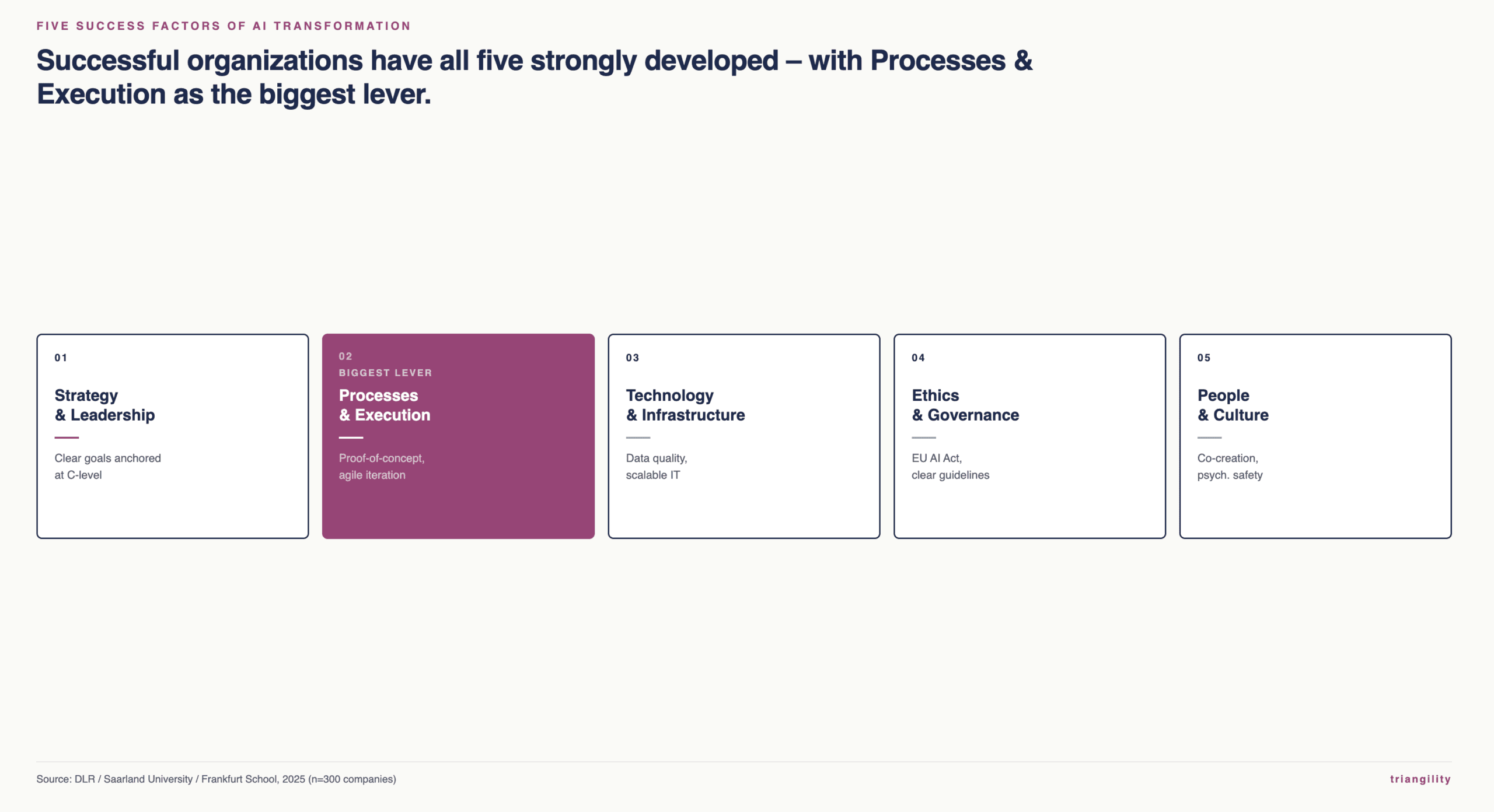
Five Success Factors of AI Transformation According to Research
A joint study by the German Aerospace Center (DLR), Saarland University, and the Frankfurt School of Finance & Management surveyed 300 private-sector companies and 30 research institutions (DLR, 2025; Frankfurt School, 2025). The result: Five success factors determine the success of an AI transformation. AI transformation leaders—that is, companies that are particularly successful in piloting and implementation—exhibit all five factors strongly. None should be neglected.
- Strategy & LeadershipA clear AI strategy at the C-level with long-term objectives and prioritized resources. Prof. Sven Heidenreich, scientific director of the study, particularly emphasizes sufficient budgets as a prerequisite for success.
- Processes & ImplementationThis factor contributes most significantly to success. A proof-of-concept approach and agile methodology first clarify feasibility, data availability, and business value before investing in full-scale implementations (Klaus Hamacher, DLR).
- Technology & InfrastructureScalable IT infrastructure that adapts to changing AI requirements. Data quality and sound data management practices are the backbone of a successful AI transformation. Effective data governance requires that the data used for AI training be clean, consistent, and secure. Companies seeking to adopt AI must become data-driven organizations by ensuring that the inputs for training AI models are properly organized and stored. For small and medium-sized enterprises, the study’s authors recommend technology partnerships (Prof. Ronald Gleich, Frankfurt School).
- Ethics & GovernanceGovernance as a standalone success factor, including the requirements of the EU AI Act, which will become mandatory in key areas starting in August 2026 (EU AI Act, 2024, Art. 14): “meaningful human oversight” by individuals with “appropriate competence” becomes a compliance requirement. Clear AI guidelines within the company are necessary to establish transparent rules and ensure the security of sensitive corporate data.
- Employees & Culture
According to the study’s findings, cultural and employee-related aspects are crucial for successful AI implementation. Employees are actively involved in designing the new AI-driven work processes to address resistance early on. AI is intended to complement work without replacing humans—the established term for this is “augmented working.” BCG adds: Successful pioneers invest around 60 percent of their AI budget in training—more than twice the average (BCG, 2025).
The question now is: How do you translate these five factors into concrete leadership actions?
Get regular access to exclusive insights from thought leaders and practical tools on topics such as digital evolution, cultural transformation, future-readiness, resilience, mindfulness, and the design of new work environments.
Guiding AI Transformation: Where Do Employees and the Organization Stand? A Look at AI Maturity
The five success factors from the DLR study outline what must be in place.
However, before taking action, you need to know where your own organization stands in terms of AI. The AI Readiness Check, our online assessment based on the integral organizational approach, closes precisely this diagnostic gap by analyzing AI maturity across 24 dimensions in four quadrants in under 30 minutes.
The four quadrants of the AI Readiness Check
The integral approach examines an organization from four perspectives simultaneously: the individual inner world, individual behavior, organizational culture, and organizational structures. Traditional maturity models usually cover only the last two. The AI Readiness Check makes all four visible.
Individual Interior: your employees’ inner attitudes toward AI.
This involves trust, emotions, psychological safety, identity, and motivation. This quadrant often determines whether a rollout succeeds or fizzles out, yet it remains invisible in almost all other assessments.
Individual Exterior: visible competencies and behaviors
Learning and development, leadership, decision-making, interaction with AI systems, AI literacy. This reveals whether leaders and teams actually master the tools or blindly trust AI output.
Organizational Interior: Your Organization’s Culture
Vision, values and ethics, innovation culture, labor relations, stakeholder relations. This quadrant determines whether AI is understood as a tool or as a threat.
Organizational Exterior: The Visible Systems and Processes
Structure, compensation, goals and KPIs, communication, products and services. Here, AI is structurally embedded or remains an initiative separate from the core business.
Why our 24 dimensions reveal more than five factors
The DLR study provides the scientific framework at the macro level. The AI Readiness Check translates this framework into a diagnosis at the micro level: 24 concrete dimensions that show exactly where the gaps lie within the organization and which levers need to be pulled next. The evaluation provides an AI Gap Analysis: strengths become visible, areas for development are identified, and concrete recommendations for action bridge the gap to the AI strategy.
→ Start the AI Readiness Check now 24 dimensions · 4 quadrants · under 20 minutes · free of charge and without registration
What leaders need to know and be able to do now
An AI transformation is driven at the leadership level or not at all. HR, People & Culture, and CIOs face the question: What competencies do our executives need for the transformation to succeed? We’ve compiled the most important ones:
Build AI literacy
Executives who delegate AI without understanding it themselves lose sight of the big picture. Not everyone needs in-depth technical knowledge for their role, and training should be tailored to specific needs. But everyone needs judgment when dealing with AI:
What is a hallucination, why does a RAG system (Retrieval-Augmented Generation) sometimes produce useful answers and sometimes useless ones, which data is in which tools, how does the General Data Protection Regulation work in the context of AI? Without this foundation, leaders will lag behind their own teams—and be vulnerable in audits. AI literacy also involves understanding one’s own limitations: Which decisions can I base on AI output, and which require a second human review?
Learning formats that have proven effective in practice include microlearning—short learning modules that can be integrated into the daily work routine—supplemented by peer learning, which promotes cross-departmental exchange about successful use cases. Training AI champions or multipliers also helps to set an example for the use of AI in daily work and to reduce reservations.
AI transformation means guiding your own team through the uncertainty
AI triggers fears: Will my job become obsolete? Will I perform worse if I trust the AI? Who will ask me anymore if the answer is already there? Leaders who brush off these questions with “We have to move with the times” will lose their team. Open communication about the change and its concrete implications is key here to alleviating fears.
A strong AI culture fosters openness to innovation, continuous learning, transparency, and trust among employees. Companies with a strong AI culture encourage employees to experiment with AI, make mistakes, and learn from them. This is precisely why company-owned AI assistants should be provided, enabling employees to experiment safely—without risk to sensitive data or compliance. This is the leadership work that stems from the “Employees & Culture” research factor.
Important to understand: Developing an AI culture is an ongoing process that must be actively shaped by leaders to build trust and create a sense of security. It is not a one-time project that is completed after the rollout, but rather an ongoing leadership task. This is the translation of the research factor “Employees & Culture” into one’s own actions.
Rethinking Workflows
AI is often introduced as a tool: ChatGPT licenses, Copilot rollouts, custom GPTs for departments. The technology is there. The work is not. A true AI transformation asks: Which of our processes no longer make sense with AI? Where are entirely new opportunities emerging that we didn’t have before AI? Which roles are changing, and which new ones are emerging? Leaders must learn to question workflows, not just roll out tools. This is the translation of the research factor “Processes & Implementation” into their own area.
Specific application areas where AI is already enabling measurable productivity gains and faster decision-making processes today: In HR, AI can be used to analyze resumes and identify suitable candidates. In customer service, chatbots answer frequently asked questions, allowing the team to focus on complex issues. In finance, operations, and sales, AI assistants accelerate data research, reporting, and proposal preparation.
The practical application of AI requires cross-departmental coordination to ensure that various AI initiatives work together effectively and do not end up in silos. A key task for HR, P&C, and CIOs is therefore to create a common framework in which the use cases of the individual departments are aligned.
Actively Shaping Ethics and Governance
With the EU AI Act, governance will become a compliance requirement starting in August 2026. But governance is more than compliance. It is the answer to the question: What do we use AI for, and what do we explicitly not use it for? Which decisions do we delegate to algorithms, and which do we retain? Where do we verify manually, and where do we trust the system? These decisions are made by executives—not IT, not Legal alone. HR and P&C must know where the lines are drawn in order to ethically account for recruiting, performance management, and people analytics. CIOs must know how governance is technically embedded so that it does not degenerate into a compliance charade.
Developing Change Fitness
The pace of AI development will not slow down. What is state-of-the-art today will be standard in twelve months. What is standard in twelve months will be obsolete in 24 months. Executives need the ability to lead in a state of perpetual uncertainty—without a roadmap, without a target state, knowing that the next wave is already on its way. Change fitness is not stress tolerance. It is a learnable leadership competency built on self-leadership, creating meaning, and systemic thinking.
This is precisely where the bottleneck lies—the point at which most AI transformations fail. You can buy tools; that much is certain. And you can have a strategy written for you. But you must develop leaders who master these five areas. And that is exactly what our AI Transformation Program is for.
How triangility helps with AI transformation
Our AI Transformation Program is designed for companies that view AI transformation as a leadership task. We combine a scientific foundation with hands-on support over six months. Because what matters is this: AI changes the entire corporate culture, the identity, and the roles themselves.
- Scientific foundation. The 17 New Leadership Principles were developed in collaboration with Karlshochschule International University and validated with executives from various industries.
- Diagnosis before the program. We start with the AI Readiness Check, which reveals the status quo across all four quadrants. From this, we work with you to determine the program’s key focus areas.
- Co-creation instead of one-size-fits-all. Every program is created in collaboration with the company—different culture, different maturity, different priorities. We interview people from various levels, not just the steering committee.
- Practical experience since 2014. We guide organizations in the automotive, financial services, pharmaceutical & healthcare, IT & telecommunications, and manufacturing sectors through transformations.
- Six months, four modules, concrete application. The Human-AI-Leadership Journey is part of our program—four modules (Leading Yourself, Leading Others, Leading Business, Leading Beyond), 17 principles, 82 methods, and over 20 Prompted Insights for immediate AI application in everyday leadership.
If you realize that the AI transformation in your company has reached the point where tools alone are no longer enough, talk to us.
Three questions you should ask every supplier
The promises on consulting websites all sound similar. Three questions will help you make your choice:
- Does the supplier cover all five success factors: strategy, processes, technology, governance, and culture? Suppliers who can only handle one aspect leave you to fend for yourself in the other areas.
- How long does the program run, and what happens after the workshop? Change takes time, iteration, and implementation phases—it’s not a one-time event.
- Who exactly does the provider speak with—just the steering committee, or also the people on the ground? AI transformation only works when the people who work with the tools every day are involved. And in the end, that’s almost the entire organization.
Frequently Asked Questions About AI Transformation
What is AI transformation in business?
AI transformation describes the strategic integration of artificial intelligence into an organization’s business models, processes, and decision-making structures. It goes beyond the introduction of individual AI tools and changes how work is done, who or what does it, and the basis on which decisions are made. According to a DLR study (2025), five success factors collectively determine success: Strategy & Leadership, Processes & Implementation, Technology & Infrastructure, Ethics & Governance, and Employees & Culture.
Why do so many AI transformations fail?
According to MIT NANDA (2025), 95 percent of all generative AI pilot projects deliver no measurable business impact—despite investments of 30 to 40 billion dollars. MIT identifies a “learning gap” between AI tools and organizations. Most failed AI initiatives fail due to a lack of leadership and the gap between tools and the organization—the technology is rarely the actual cause.
What distinguishes AI transformation from digitalization?
Digitalization changes how work is done—tools, processes, data flows. AI transformation changes who or what does the work and the basis on which decisions are made. Traditional change management with a defined target state reaches its limits here because AI technologies change faster than any roadmap.
What success factors determine the outcome of an AI transformation?
The joint study by DLR, Saarland University, and Frankfurt School (2025) identifies five success factors: Strategy & Leadership, Processes & Implementation, Technology & Infrastructure, Ethics & Governance, and Employees & Culture. Processes & Implementation—specifically proof-of-concept approaches and agile methodologies—contribute the most to success. AI transformation leaders have all five factors strongly in place; none should be neglected.
Who is responsible for AI transformation?
Responsibility for a successful AI transformation lies at the C-level. A clear AI strategy anchored at the top management level is crucial for success (DLR, 2025). Best practice: A designated individual at the executive level leads the AI transformation with a clearly defined mandate covering all five success factors. HR, P&C, and IT are partners, not sole owners.
What competencies do executives need for AI transformation?
In AI transformation, leaders need five core competencies: AI literacy (understanding the technology itself), the ability to lead teams through uncertainty, workflow thinking (beyond tools), actively shaping ethics and governance, and change fitness as a lasting leadership competency. These competencies can be learned but require targeted programs—not just training.
How do you measure the success of an AI transformation?
Traditional productivity KPIs only partially capture success. They often show positive metrics, while loss of competence and erosion of meaning remain invisible. Meaningful KPIs include skill tests (rather than self-assessment), autonomy and a sense of purpose within teams, turnover intentions, and the proportion of problems solved independently without AI assistance. A more in-depth discussion can be found in our article on KPIs for AI-driven leadership.
How do you develop an AI strategy?
An effective AI strategy is supported by senior management and linked to specific business objectives. It is more than a collection of individual AI projects. A good strategy clearly defines which problems AI is intended to solve, which resources are available for this purpose, and which use cases are explicitly not being pursued. Start with the most pressing business needs, not the most technologically exciting ones. An iterative approach with short learning cycles is far superior to overly ambitious large-scale programs.
What role does culture play in AI transformation?
According to a DLR study (2025), culture is one of five equally important success factors—and the one where rollouts most often fail silently. A sustainable AI culture is based on psychological safety, continuous professional development, and practical application. It is characterized by actively involving employees in the design of new AI work processes to resolve resistance early on. Fundamentals such as prompt engineering and data protection are mandatory for all employees, with subject-specific training supplementing this foundation depending on the department.
What is an AI Readiness Check?
An AI Readiness Check is a systematic analysis of an organization’s AI maturity level. The triangility AI Readiness Check evaluates how ready a company is for AI transformation across 24 dimensions in 4 quadrants—ranging from individual competencies to internal culture and organizational structures. The assessment takes less than 20 minutes, is free of charge, and provides an AI gap analysis with concrete recommendations for action.
What are the specific areas of application for AI in companies?
AI is used across industries in companies—most visibly today in human resources (resume analysis, identification of suitable candidates), in customer service (chatbots for frequently asked questions, triage of inquiries), as well as in finance, operations, and sales (data research, reporting, quote preparation). Practical implementation requires cross-departmental coordination to ensure that various AI initiatives work together and do not end up in silos.
What role does data play in AI transformation?
Data quality and sound data management practices are the backbone of a successful AI transformation. Companies looking to adopt AI must become data-driven organizations—they must ensure that the inputs used to train AI models are properly organized and stored. Effective data governance requires that the data used for AI training be clean, consistent, and secure. Clear AI policies establish transparent rules for handling sensitive corporate data.

Develop AI leadership skills: The only learning journey for leaders that combines artificial intelligence, new leadership, and AI transformation.
Join our New Leadership Community:
We send you our monthly newsletter on leadership, culture, organization and technology. With exciting, curated inspiration for the new world of work.

Get in Touch
Contact Verena for personalized information on how to become more mindful as a leader.
You are currently viewing a placeholder content from Zoho Forms. To access the actual content, click the button below. Please note that doing so will share data with third-party providers.
More Information