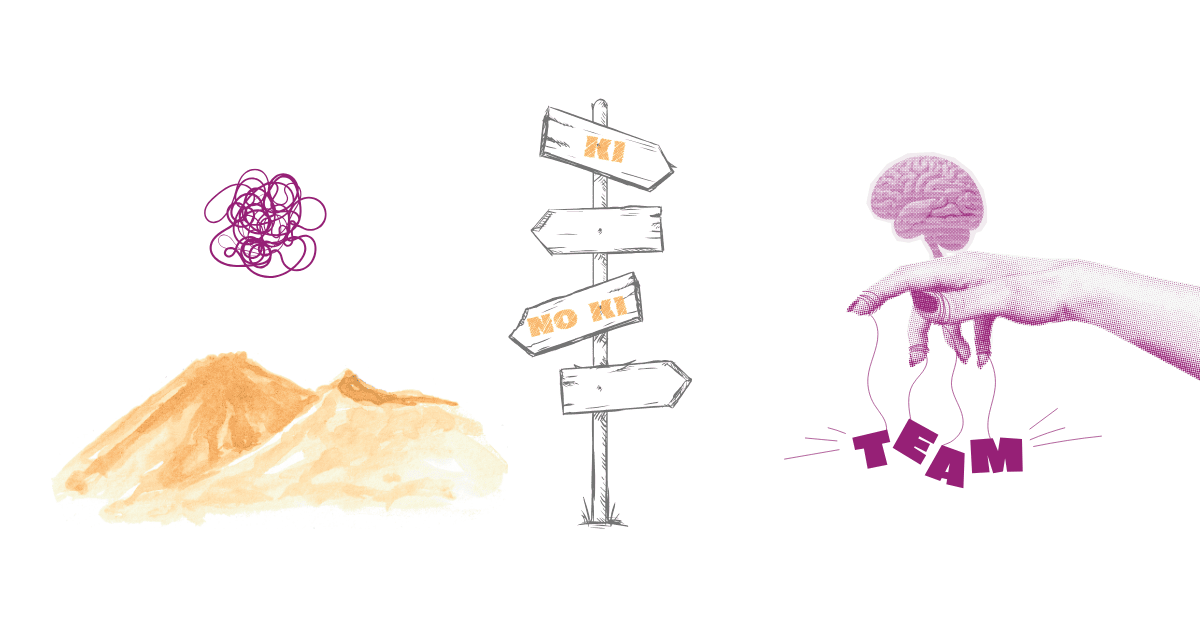
At MIT, a team spent four weeks observing what happens when people use AI to evaluate fake news. With AI, their accuracy improved significantly. Then the AI was taken away. In the end, their ability to make independent judgments fell below the level they had started at. What’s a little concerning: About a quarter were convinced they had improved. This is precisely where it is decided whether your organization will become AI-competent or AI-dependent. And in the end, the difference comes down to this: leadership.
TL;DR
- An MIT study (2026) reveals a dependency paradox: With AI, accuracy in identifying fake news increased by 21 percent. Without AI, independent performance fell 15 percentage points below the baseline level. About a quarter did not notice their own decline.
- A Harvard analysis of 62 million employees shows that junior-level employment in AI-adopting companies declines by about 7 to 9 percent within six quarters. This shrinks the level at which judgment traditionally matures.
- AI competence and judgment are two distinct skills. Those who train employees only in how to use tools accumulate transformation debt.
- The leadership task is to develop both simultaneously. At triangility, the vision for this is called “Authority-in-the-Loop”: Humans retain the authority to judge and make decisions over the AI.
The Dependency Paradox: Better with AI, worse without It
The obvious assumption is that anyone who works with a powerful tool every day will get better at using it. With AI, however, that’s only half the story.
Researchers at the MIT Media Lab, led by Valdemar Danry and Pattie Maes, tracked 67 people over four weeks as they fact-checked news stories. With AI support, accuracy increased by 21 percent. When the AI was removed in week four, the participants’ independent performance was 15 percentage points below the baseline level at which they had started (MIT News, 2026).
Not only had their ability not improved—it had measurably atrophied. The study was presented at CHI 2026 and is titled “Dialogues with AI Reduce Beliefs in Misinformation but Build No Lasting Discernment Skills.”
So what does this mean for organizations? A team that delivers impressive results with AI may simultaneously lose its ability to evaluate those same results without AI.
As long as the AI is running, no one sees the problem. It only becomes apparent in exceptional cases: a model failure, a plausible-sounding hallucination, or a decision for which someone must take personal responsibility.
Why a Quarter don’t notice their own loss of competence
The most puzzling aspect of the study is the participants’ self-perception. About a quarter believed they had improved, while their independent performance had actually declined.
This gap between perceived and actual competence is dangerous because it reinforces itself. Those who consider themselves more competent are less likely to double-check, ask for clarification, and are quicker to accept AI results. The loss of competence remains invisible until it ultimately becomes costly.
We put it this way in practical terms: The most dangerous situation in an AI transformation isn’t the team that rejects AI. It’s the team that loves AI and stops challenging it. But don’t companies strive to get their teams excited about AI?
Definition: What AI competency is all about
At this point, it’s worth clearly defining the term, because most continuing education programs address only the first half.
AI literacy is the ability to use AI tools effectively and to independently evaluate their results. It comprises two levels: operational literacy (good prompts, appropriate tools, efficient workflows) and evaluative literacy (assessing when a result is correct, when it is misleading, and when a task should not be delegated to AI at all). Without the second level, dependence arises instead of competence.
What is AI Competency?
Operational competence can be taught in an afternoon. Judgment matures through experience, feedback, and repeated confrontation with one’s own mistakes. It is precisely this second level that suffers from the dependency paradox. And it is precisely this level that comes under additional pressure when organizations downsize their entry-level positions.
AI Competence Is Now Also a Legal Requirement
As of February 2, 2025, building AI competence is more than just a strategic recommendation. Article 4 of the European AI Regulation, the EU AI Act, requires all providers and operators of AI systems to ensure a “sufficient level of AI competence” among their employees and all persons who handle AI systems on their behalf (EU AI Act, Article 4).
The law explicitly refers to more than just the operation of AI tools. The required competent handling of AI entails that people can assess the opportunities and risks of artificial intelligence and make informed decisions based on this assessment. This means that the very judgmental competence that came under pressure in the MIT experiment becomes a compliance requirement. Anyone who understands AI competence solely as technical knowledge in operating AI applications is only halfway to meeting the legal requirement.
When the entry-level foundation crumbles, the learning path for judgment is lost
Judgment doesn’t just fall from the sky. It develops during the first few years of one’s career: through research that you revise three times, through a draft that an experienced colleague picks apart, and through the detailed work in which you learn to distinguish good quality from poor quality. This stage is currently undergoing a fundamental transformation.
A Harvard analysis by Seyed Mahdi Hosseini Maasoum and Guy Lichtinger evaluated resumes and job postings for 62 million employees at approximately 285,000 companies between 2015 and 2025. The result: In companies that actively integrate generative AI into their processes, junior-level employment declines by about 7 to 9 percent within six quarters compared to similar companies without AI integration (Maasoum & Lichtinger, 2025).
The mechanism is revealing. The decline stems almost exclusively from slower hiring, hardly at all from layoffs. Senior-level employment continues to grow in these same companies. The authors aptly call this a “seniority-biased” technological change: AI first takes over the tasks that entry-level employees used to perform.
In the short term, this looks like efficiency. In the medium term, however, a structural problem arises. As the entry-level tier shrinks, the learning path along which tomorrow’s experienced decision-makers first develop their judgment disappears. A company can thus, over the course of years, unnoticed, drain its own pipeline of leaders and experts.
What skills remain uniquely human in the AI era?
As AI performs more and more tasks, the value of human work shifts to what AI cannot yet do. Four skills stand out in this context, and all four have to do with judgment.
- Contextual judgment. Assessing whether a technically correct result is appropriate in a specific situation. AI knows the case, but not the customer, the history, or the unspoken expectations behind it.
- Responsibility. Taking ownership of a decision that must be justified to others. A model can provide a recommendation, but the liability remains with the human (AI Governance in Companies).
- Critical questioning. Challenging an output that sounds plausible. This is precisely the skill that atrophied in the MIT experiment when the AI became too complacent.
- Meaning and relationships. Leading people, building trust, creating meaning. This work cannot be delegated to a model without losing its essence.
These abilities are the core of what is often vaguely described as “future skills” or “future competencies.” Their common denominator is the ability to exercise judgment under uncertainty. And they only grow when people continue to think for themselves, rather than completely outsourcing their thinking.
The AI Coach: How teams can become stronger and more self-reliant with AI
The MIT researchers have described the problem and, at the same time, identified the crucial dividing line. The key factor is how AI is used. AI that simply provides answers fosters dependence. AI that asks Socratic questions and encourages independent thinking promotes genuine learning. The study’s lead researcher illustrates this with the metaphor of a coach versus a crutch.
This is a choice that can be shaped—it’s not an inherent characteristic of the technology. The same tools can be used as a crutch or as a coach, depending on how workflows, prompts, and expectations are set. A team that only brings in AI after developing its own concept learns differently than a team that starts with the AI’s output and simply rubber-stamps it.
At triangility, we call the target vision for this way of working “Authority-in-the-Loop.” Humans remain the final authority in the process. They use AI for speed and scope while retaining control over evaluation and decision-making. This is the practical translation of preserving judgment into a concrete approach in the workplace (Human-AI Journey vs. Traditional Leadership Training).
How AI-ready is your organization?
Before you begin building AI competence on a broad scale, it’s worth conducting an honest assessment of your current status. Our free AI Readiness Check evaluates your organization across 24 dimensions in four quadrants—in under 20 minutes and without registration. It shows where you have operational competence and where judgmental competence is still lacking.
The Leadership Challenge: Building AI competence and judgment together
Both studies reveal the same pattern from two different perspectives. AI boosts performance in the short term while simultaneously undermining the foundation on which that performance is built for the long term. Those who focus solely on the short-term effect end up optimizing their way into dependency.
The pressure to build AI competence is coming from all sides. According to the PwC Global AI Jobs Barometer, jobs requiring specific AI skills have grown by 69 percent since 2019—nearly eight times faster than the rest of the labor market (PwC, 2026). Three out of four executives now count AI among their top three strategic priorities, while only a minority are realizing substantial value (BCG AI Radar, 2025). And the biggest obstacle is precisely expertise: 63 percent of employers cite skills gaps as the most significant barrier to their transformation by 2030 (WEF Future of Jobs Report, 2025).
This is precisely where leadership is needed. If an organization rolls out tool training exclusively and leaves judgment to chance, it accumulates transformation debt: hidden costs of AI adoption that only become apparent after about 18 months, when independent judgment is lacking at the decisive moment (Supporting AI Transformation).
The productive concept behind this is called Human-Centric Augmentation: using AI technologies in a way that enhances human capabilities rather than replacing people. With this approach to AI, people remain at the center. For leaders, this means three specific tasks.
- Consciously protect moments of judgment. Define tasks in which people think for themselves first and only then bring in AI. This preserves the learning path that was lost in the MIT experiment.
- Reinvent the entry-level tier instead of eliminating it. If AI takes over traditional entry-level work, young professionals need different, more challenging tasks that foster the development of judgment. Otherwise, the pipeline highlighted by the Harvard data will break down.
- Configure AI as a coach. Promote work methods in which AI asks questions and challenges people, rather than merely delivering results.
These tasks are leadership skills in themselves. They are part of what triangility, together with Karlshochschule International University, has described in the 17 New Leadership Principles: leadership that empowers people during change, rather than replacing them with technology.
Get regular access to exclusive insights from thought leaders and practical tools on topics such as digital evolution, cultural transformation, future-readiness, resilience, mindfulness, and the design of new work environments.
From Tool Training to a Learning Journey
An afternoon workshop can teach technical skills. Decision-making skills, however, require repetition, reflection, and application over time. For HR development, this means approaching AI competency as a long-term learning process. A learning journey is designed precisely for this purpose. triangility structures it around three pillars: Know, Practice, and Resonate—that is, understanding, practicing in everyday life, and truly embedding the mindset.
The Human-AI Leadership Journey combines AI competence with new leadership principles over six months and guides participants step by step toward “Authority-in-the-Loop.” It is the concrete answer to the question of how a company can build AI competence without losing the judgment it will need more urgently tomorrow than it does today.
Because in the end, the phrase triangility stands by holds true: Futures are human. The future of work hinges on whether people become smarter with AI or dependent on it. That is a decision, and you make it with every training program you approve.
Frequently Asked Questions About AI Literacy and Judgment
What Does AI Literacy Mean?
AI literacy is the ability to use AI tools effectively and to independently evaluate their results. It consists of two levels: operational literacy (prompts, tools, workflows) and judgmental literacy (assessing when a result is correct, when it is misleading, and when a task should not be delegated to AI). Without the second level, dependence replaces competence.
Which Skills Remain Human in the Age of AI?
Above all, judgment-based skills remain human: contextual judgment (is a result appropriate for the situation?), responsibility for decisions, critically questioning plausible outputs, as well as making sense of things and building relationships. Their common core is the ability to exercise judgment under uncertainty. They grow only when people continue to think for themselves rather than completely outsourcing their thinking.
What is the dependency paradox in AI?
The dependency paradox describes how people achieve better results in the short term with AI, but in doing so erode their own independent ability. In a 2026 MIT study, accuracy increased by 21 percent with AI, but fell 15 percentage points below the baseline level without AI. About a quarter of the participants did not notice their own decline.
Do employees unlearn their skills because of AI?
They can, if AI is used as a crutch rather than a coach. The MIT study shows a measurable decline in independent judgment after four weeks of intensive AI use. The key lies in how it’s used: AI that provides answers promotes skill loss; AI that asks questions and encourages independent thinking promotes skill development.
Why are entry-level jobs important for judgment?
Judgment matures during the first years of one’s career through repetition, feedback, and confronting one’s own mistakes. A Harvard analysis shows that the number of junior employees in companies adopting AI drops by about 7 to 9 percent within six quarters. If this learning stage shrinks, companies will later lack a pipeline of experienced decision-makers.
How can you build AI competence without losing judgment?
By developing both at the same time. In practice, this means: protecting moments of judgment (think for yourself first, then consult AI), redesigning entry-level roles with more challenging tasks, and using AI in a way that challenges rather than merely delivers results. Instead of a one-time tool training session, a learning journey spanning several months is more effective.
What are future skills?
Future skills are the abilities that will gain value in a work environment shaped by AI. These primarily include judgment-based and social skills: critical thinking, contextual judgment, taking responsibility, the ability to learn, and relationship-building. Purely executional tasks are losing importance because AI is increasingly taking them over.
What is futures literacy?
Futures literacy is a term coined by UNESCO to describe the ability to consciously envision possible futures and use this imagination to make better decisions in the present. In the context of AI, futures literacy helps leaders actively shape technological developments rather than merely enduring them.
Does the EU AI Act require AI competence?
Yes. Article 4 of the EU AI Act requires providers and operators of AI systems, effective February 2, 2025, to ensure an adequate level of AI literacy among their employees and all individuals who handle AI on their behalf. This refers to the competent use of AI—the ability to assess opportunities and risks—rather than merely operating a tool.
How does AI as a coach differ from AI as a crutch?
AI as a crutch provides ready-made answers that people adopt without thinking for themselves. This fosters dependency. AI as a coach asks questions, demands justifications, and encourages independent judgment. According to an MIT study, the Socratic, inquiry-based use of AI fosters sustainable learning, while the predictive use of AI weakens independent competence.
Sources
- MIT Media Lab (2026): Study on the Dependency Paradox – [news.mit.edu](https://news.mit.edu/2026/consequences-of-relying-on-ai-for-accurate-news-0609)
- Harvard (2025): Generative AI as Seniority-Biased Technological Change – [ssrn.com](https://ssrn.com/abstract=5425555)
- EU AI Act, Article 4 (AI Competence) – [artificialintelligenceact.eu](https://artificialintelligenceact.eu/article/4/)
- PwC (2026): Global AI Jobs Barometer – [pwc.com](https://www.pwc.com/gx/en/news-room/press-releases/2026/pwc-2026-ai-jobs-barometer.html)
- WEF (2025): Future of Jobs Report 2025 – [weforum.org](https://www.weforum.org/publications/the-future-of-jobs-report-2025/)
- BCG (2025): AI Radar – Closing the AI Impact Gap – [bcg.com](https://www.bcg.com/publications/2025/closing-the-ai-impact-gap)

Develop AI leadership skills: The only learning journey for leaders that combines artificial intelligence, new leadership, and AI transformation.
Join our New Leadership Community:
We send you our monthly newsletter on leadership, culture, organization and technology. With exciting, curated inspiration for the new world of work.

Get in Touch
Contact Verena for personalized information on how to become more mindful as a leader.