36 percent of companies in Germany now use artificial intelligence. Over 80 percent of them still see no measurable impact on their bottom line. The real challenge of digital transformation lies between these two figures. Access to technology has been resolved. But the question of how to turn an AI program into a result that translates into numbers, behavior, and competitiveness remains unanswered far too often. This is exactly where quality consulting in digital transformation comes in. This article explains why programs fail today, what matters most in the implementation process, and how to truly measure the impact within companies.
TL;DR
- Only 26 percent of companies achieve measurable added value with AI. 74 percent never get past the proof-of-concept stage (BCG, 2024).
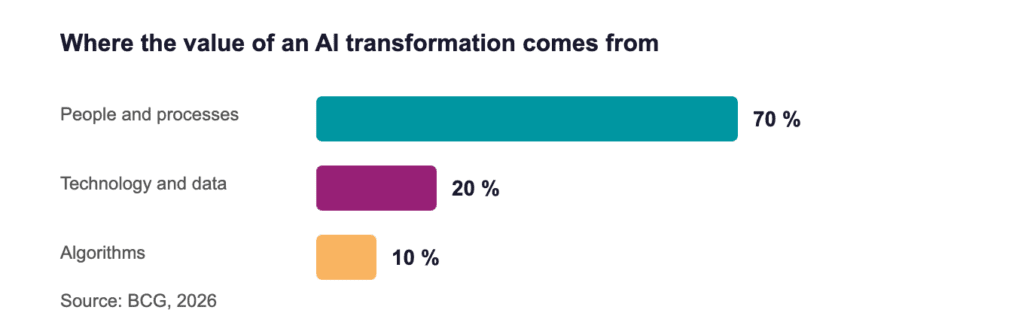
- About 70 percent of the hurdles in AI transformations are related to people and processes, 20 percent are technology-related, and 10 percent concern the algorithms themselves (BCG, 2024).
- Across all industries, digital and AI pioneers outperform laggards by a factor of two to six in terms of total shareholder return (McKinsey, 2024).
- This article provides a clear definition, the core areas of transformation, a three-phase roadmap, and the criteria for identifying effective consulting.
What does “digital transformation consulting” mean?
Digital transformation and consulting involve providing structured guidance to companies to help them integrate digital technologies and artificial intelligence into their strategy, processes, business models, and culture in a way that yields measurable results. It connects technology decisions with the people who will adopt these new ways of working.
Meaning of digital transformation
The essence of this definition lies in the last sentence. A consulting firm that merely introduces tools leaves behind tools. A consulting firm that empowers people and rethinks processes leaves behind an impact. External support helps in three key ways: It provides an outside perspective on one’s own organization, it draws on experience from many comparable programs, and it keeps the process moving when day-to-day operations would otherwise slow it down.
Digitalization, Digital Transformation, and AI Transformation: A Comparison
Three terms that are often used interchangeably in everyday language actually mean very different things upon closer inspection:
- Digitalization – the conversion of analog processes into digital ones. A paper form becomes an online form. The process remains the same.
- Digital transformation—the fundamental rethinking of processes, business models, and customer relationships based on digital possibilities. The process itself changes.
- AI transformation—the stage at which artificial intelligence helps shape decisions, interactions, and value creation. Here, the way knowledge is generated and applied within the company changes.
Those who confuse these stages are thinking too small. After all, a digitized form is far from being a sustainable business model.
From Digital Transformation to AI Transformation
The past few years have been dominated by the digitization of processes. The current leap, however, is different. Artificial intelligence is becoming a driver that goes beyond merely accelerating workflows and is now influencing analysis, communication, and decision-making. Adoption is happening at a breakneck pace: In Germany, 36 percent of companies now use AI—nearly twice as many as the previous year—and another 47 percent are planning or discussing its implementation (Bitkom, 2025). Globally, 71 percent of companies regularly use generative AI in at least one business function (McKinsey, 2024).
Digital transformation and AI transformation must therefore be considered together. Those who separate the two end up developing two separate strategies, two separate governance frameworks, and two separate change management processes.
The Goal: Future-Proofing Business Models
Ultimately, it’s about adaptability. A successful transformation makes business models more resilient to market changes and lays the foundation for responding more quickly to new developments. Technology is the means to this end. The goal is a company that will still be capable of acting effectively five years from now.
Why Companies Seek External Consulting
Most organizations could, in principle, tackle transformation on their own. In practice, they seek guidance because external consulting makes a difference in three key areas.
1. A digital strategy roadmap aligned with business objectives
The most common mistake is starting with technology. A robust roadmap begins with business objectives and translates them into digital initiatives with clear priorities. This creates a sequence that follows business needs rather than hype. And it’s the only way to assess later on whether a program has been effective.
2. Minimizing risks, building buy-in
Professional guidance reduces two risks at once. It prevents costly misinvestments in technology that no one uses. And it ensures that new ways of working are embraced by the people who are supposed to implement them. Adoption is not a “soft” factor. It determines whether a program will even become part of everyday life.
3. Data-Driven Decisions and More Efficient Workflows
Properly structured data analyses enable strategic and operational decisions based on facts. Automated and streamlined workflows reduce costs and free up time for work that people do better than machines. The benefits become apparent where both efficiency and quality improve simultaneously.
The Core Areas of Digital Transformation
Transformation is rarely a single project. It touches on five areas of action that must work together:
area of action | what it is about | typical questions |
|---|---|---|
strategy and business model | Aligning digital initiatives with corporate goals | Where will value be created in the future? Which model will be viable in five years? |
Processes and Automation | Redesigning workflows, implementing automation and AI | Which processes are we fundamentally changing? What are we automating? |
Data and Technology | Data infrastructure, AI, cloud, connectivity | Is our data usable? Which technology supports our goal? |
Customers and Customer Experience | Digital customer experiences and new touchpoints | How are expectations changing? Where are we engaging customers in new ways? |
People, Culture, and Leadership | Skills, Acceptance, Leadership Approach, Collaboration | Are our people able and willing to adapt? How do we lead through change? |
The last area is most often underestimated. And it has the greatest impact.
The Special Case of Industry 4.0 and Manufacturing
In manufacturing companies, the transformation takes on a depth of its own. Industry 4.0 connects machines, sensors, and systems, while AI analyzes the resulting data and optimizes production, maintenance, and supply chains. The areas of focus remain the same, but the technical complexity and the level of investment are higher. This makes the order in which a program proceeds all the more important.
Get regular access to exclusive insights from thought leaders and practical tools on topics such as digital evolution, cultural transformation, future-readiness, resilience, mindfulness, and the design of new work environments.
Why Most AI Transformations Fail to Deliver Value
Herein lies the uncomfortable truth of this article. Investments are being made, but results are lacking. Only 26 percent of companies achieve measurable added value with AI, while 74 percent never move beyond individual pilot projects (BCG, 2024). In line with this, over 80 percent of companies report no tangible impact of generative AI on their operating results (McKinsey, 2024).
The blind spot: Technology is planned, but adoption is not
Why this gap? The answer lies in one of the clearest figures from current research. About 70 percent of the challenges in AI transformations are related to people and processes, 20 percent concern technology and data, and only 10 percent relate to the algorithms themselves (BCG, 2024). Most programs invest their energy the other way around. They plan the technology in detail and treat adoption as an afterthought.
Human-Centeredness as a Success Factor
Let’s put it more bluntly: An AI transformation is 70 percent a leadership and cultural task. That’s why triangility’s Human-Centered AI approach puts people at the center. AI enhances human capabilities rather than replacing them. For this to succeed, an effective transformation changes the logic of leadership, the decision-making processes, and the culture in which knowledge can take effect. The 17 Principles for New Leadership, which triangility developed in collaboration with Karlshochschule International University, provide the leadership framework for this.
Impact Instead of Daily Work: The Results-Oriented Consulting Approach
The consulting industry itself is under pressure to rethink its model. If a program is measured by the number of consulting days, no one measures the outcome. It makes more sense to ask what impact is achieved in the end. The return on this approach is verifiable: Across industries, digital and AI pioneers outperform laggards in total shareholder return by a factor of two to six; in the banking sector, this translates to an annual return of about 8 percent versus about 5 percent (McKinsey, 2024).
How to Measure the Impact in the End
Impact requires different metrics than mere activity. Instead of counting consulting days, it’s worth looking at:
- Adoption rate – how many people are actually using the new ways of working.
- Engagement – how actively teams are working with the new tools.
- Time and cost savings – where processes are measurably faster or more cost-effective.
- Business impact – the contribution to earnings, visible over a defined period.
Those who define these metrics before launching the initiative make success verifiable.
Three Phases of AI Transformation: The Human-AI Journey
Transformation rarely happens in one fell swoop. The path outlined by triangility—the Human-AI Journey—guides organizations through three phases.
- Diagnosis – The AI Readiness Check provides initial guidance. It assesses an organization’s readiness for AI across 24 dimensions in four quadrants, ranging from individual competencies to organizational structures.
- B AnalysisB – The diagnosis leads to a gap analysis and prioritization. Here, decisions are made about where the greatest leverage lies and the order in which the program will proceed.
- Embedding – Embedding AI into everyday life through labs, prototypes, and community. In this phase, a concept becomes lived practice.
Getting Started: Our AI Assessment
The first step is an assessment of the current state. The AI Readiness Assessment shows where an organization stands on its journey and provides concrete recommendations on how to shape the transformation holistically. It is the entry point to our AI Transformation Program.
Change Management and Empowerment: People at the Center
If 70 percent of the hurdles lie with people, then that is also where the key lies. Effective change management turns those affected into active participants. It creates a sense of psychological safety where questions and doubts are welcome. And it takes resistance seriously rather than ignoring it.
Skill Development and Upskilling
Technology changes faster than skills. That’s why systematic skill development is an essential part of every transformation program. Through learning journeys and training programs like AI for Managers, leaders and teams learn to apply AI in their own work contexts. A practical starting point for this is the 7-Step Dialogue for Human-AI Collaboration.
Responsible AI and Acceptance
Trust is the currency of AI transformation. Clear guidelines for AI use, transparent responsibilities, and a conscious approach to ethics determine whether people will embrace the new tools. Those who take their workforce’s concerns seriously gain acceptance. Those who ignore them provoke resistance.
Digital Transformation Consulting in Practice
In practice, transformation looks different depending on the industry. In manufacturing, it’s about connected systems and predictive maintenance. In retail, it’s about digital customer experiences and personalized offers. In services and administration, it’s about automated processes and faster decision-making. There’s good news for small and medium-sized businesses: Transformation doesn’t require a corporate-level budget. It requires a clear sequence of steps, the courage to prioritize, and, ultimately, empowering your own people.
What to Look for When Choosing a Consulting Firm
The market for digital transformation consulting is confusing. Five criteria can help with your selection:
- AI and industry expertise – Does the consulting firm understand both your business and the technology equally well?
- People-centric approach – Is the focus on empowering people, or just on introducing tools?
- Focus on impact – Are measurable goals agreed upon in advance to demonstrate success?
- Empowerment Instead of Dependence – Does the consulting firm build up your company’s own expertise so that you can move forward without them in the end?
- Clear Communication – Do all stakeholders speak the same language, even beyond technical jargon?
So the question you should ask yourself is: Does this consulting firm make us more independent or more dependent?
Hint: The best consulting firm is the one you won’t need anymore later on.
Conclusion: Transformation Succeeds When It Is People-Centric and Impact-Driven
The figures in this article paint a clear picture. Technology is available, but value is rarely created. The difference between the 26 percent that achieve results and the 74 percent that get stuck in the pilot phase rarely lies in the technology. It lies in the people, the processes, and leadership. Good digital transformation consulting starts exactly there. It begins with an honest assessment of the current state, aligns every initiative with the company’s goals, and makes impact measurable.
Take the first step with an assessment. The AI Readiness Check from triangility shows you, across 24 dimensions, how ready your organization is for AI transformation and where your greatest levers for change lie.
Frequently Asked Questions About Digital Transformation Consulting
What is digital transformation consulting?
Digital transformation consulting is the structured support provided to companies as they integrate digital technologies and artificial intelligence into their strategy, processes, business models, and culture. The goal is to achieve measurable results that are reflected in efficiency, competitiveness, and the acceptance of new ways of working.
What is the difference between digitization and digital transformation?
Digitization converts existing analog processes into digital ones, while the process itself remains the same. Digital transformation fundamentally rethinks processes, business models, and customer relationships. Digitization is thus a building block; digital transformation is the overarching change.
How much does digital transformation consulting cost?
The costs depend on the scope, duration, and objectives. More meaningful than the daily rate is the question of impact: What measurable results does the program promise, and how will they be assessed? A results-oriented approach defines these goals before the start.
How long does a digital transformation take?
A digital transformation is an ongoing process, not a one-time project. The first visible results often emerge within a few months, but the fundamental change in culture and leadership takes longer. A phased approach with clear interim goals is crucial.
Which technologies are driving the transformation?
The most important drivers are artificial intelligence and machine learning, cloud computing, the Internet of Things, automation, and data analysis. In manufacturing companies, connectivity in the context of Industry 4.0 is also a key factor. Which technology makes sense depends on the company’s goals.
Why do so many AI transformation projects fail to deliver value?
Because the focus is usually on the technology, and people are brought on board too late. About 70 percent of the hurdles in AI transformations are related to people and processes; only 10 percent concern the algorithms (BCG, 2024). Those who plan for adoption and skill-building maximize value.
How do you measure the success of a digital transformation?
Success is reflected in key metrics defined before the project begins: adoption rate, team engagement, measurable time and cost savings, and the contribution to business results. Pure activity metrics, such as the number of consulting days provided, say little about the actual impact.
How do SMEs benefit from digital transformation?
Small and medium-sized enterprises benefit from leaner processes, better data-driven decisions, and new customer contacts. They don’t need a corporate-level budget, but rather clear prioritization, a phased approach, and the empowerment of their own employees.

Develop AI leadership skills: The only learning journey for leaders that combines artificial intelligence, new leadership, and AI transformation.
Join our New Leadership Community:
We send you our monthly newsletter on leadership, culture, organization and technology. With exciting, curated inspiration for the new world of work.

Get in Touch
Contact Verena for personalized information on how to become more mindful as a leader.